“Heavy duty” is printed on a lot of paper plate packaging, but it is a marketing phrase, not a specification. What actually separates a plate that holds a loaded barbecue portion from one that folds and drips on someone’s lap comes down to three physical properties: the weight of the board, how that board is built, and what it is coated with. If you are ordering custom-printed plates for an event, a venue, or a brand, those same three properties also decide how cleanly your artwork prints. This is a look at what is really going on inside a paper plate and how to choose the right build.
Board weight is the foundation
The first number that matters is the paperboard weight, measured in grams per square meter, or GSM. Heavier board resists bending, so GSM is the closest thing to a single sturdiness dial a plate has. As a rough guide, economy plates around 150 to 190 GSM are thin and floppy and are really only suited to dry snacks. Standard party plates in the 200 to 250 GSM range are noticeably stiffer and hold their shape when lifted by the edge, which covers most everyday party food. Genuine heavy-duty plates run about 280 to 350 GSM and stay rigid under wet, heavy meals like pasta or barbecue, while premium board at 400 GSM and up feels like cardstock and is built for formal, standing receptions where guests balance a plate in one hand. The chart below maps these tiers so you can match the weight to how the plate will actually be used.
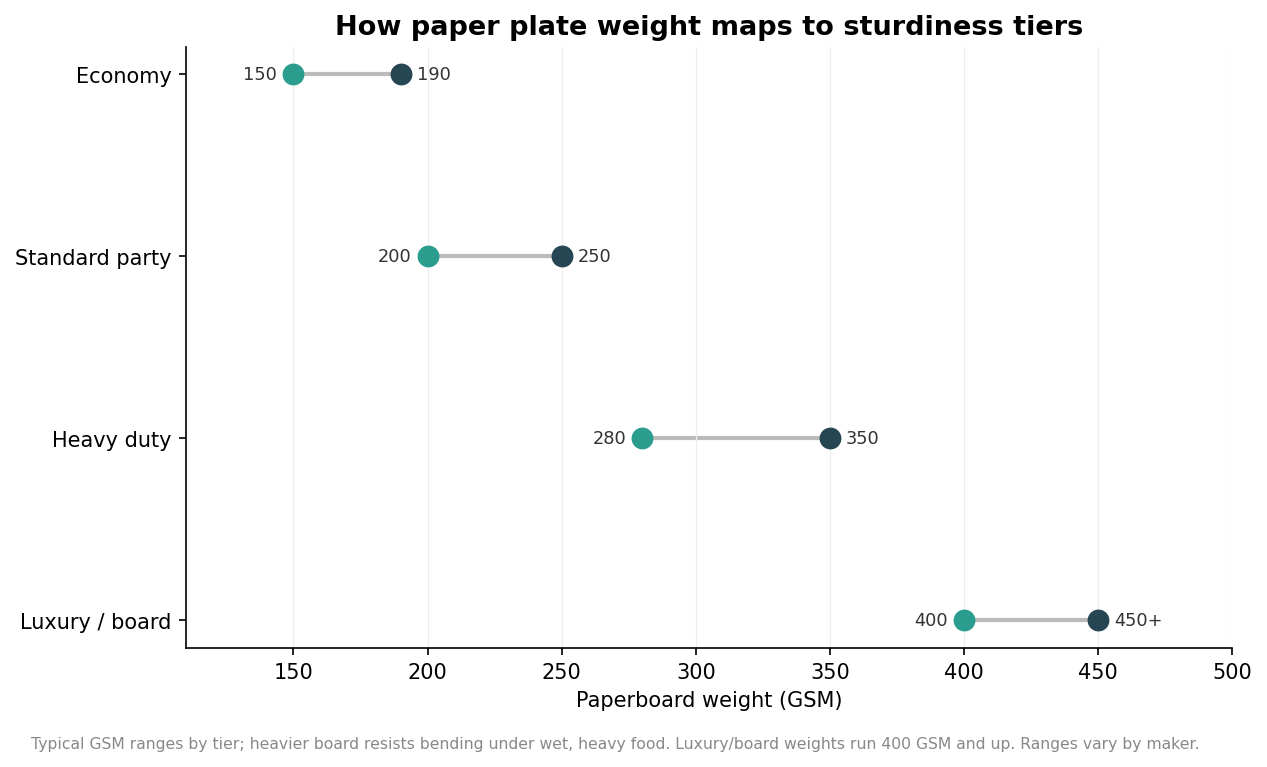
The practical lesson is to buy the weight the food demands rather than the cheapest option. A saucy or hot main on a 190 GSM plate is a spill waiting to happen, while a 350 GSM plate under a couple of cookies is money spent on rigidity nobody needed.
How the board is built
Weight is not the whole story, because two plates of the same GSM can behave differently depending on construction. Better plates use multiple laminated plies rather than one thick sheet, which improves burst strength and puncture resistance and gives a more useful balance of stiffness and flexibility. The rim matters just as much as the base. A multi-pleat rim with tightly crimped folds distributes stress far better than a shallow flat rim, and a deep embossed channel around the perimeter adds rigidity exactly where a plate tends to sag. When you compare samples, press gently in the center and lift from one edge; a well-built plate resists folding along its diameter, which is the failure that dumps food.
Coatings decide grease, moisture, and heat
The coating is the barrier between the food and the board, and it is where several buying decisions collide. An uncoated plate soaks through quickly, so any greasy or wet food needs a barrier of some kind. Polyethylene coatings give excellent grease and moisture resistance but can soften if microwaved and complicate composting. PLA is a plant-based alternative with good resistance and better end-of-life options, though microwave and heat tolerance vary by product, so check the label. Water-based, or aqueous, coatings offer strong grease and moisture performance and are generally the safest choice for microwave use. Wax is a low-cost barrier that melts under heat and handles wetness poorly. Clay coating is used mainly to create a smooth, bright surface that prints beautifully, but it adds little barrier on its own. Bagasse, made from sugarcane fiber, is naturally oil and grease resistant without a separate coating and is a common route to compostable, PFAS-free plates. Match the coating to the food and to whether guests will reheat leftovers, and verify any compostability or microwave claim against the manufacturer’s own testing rather than assuming it.
Size is a separate decision from strength
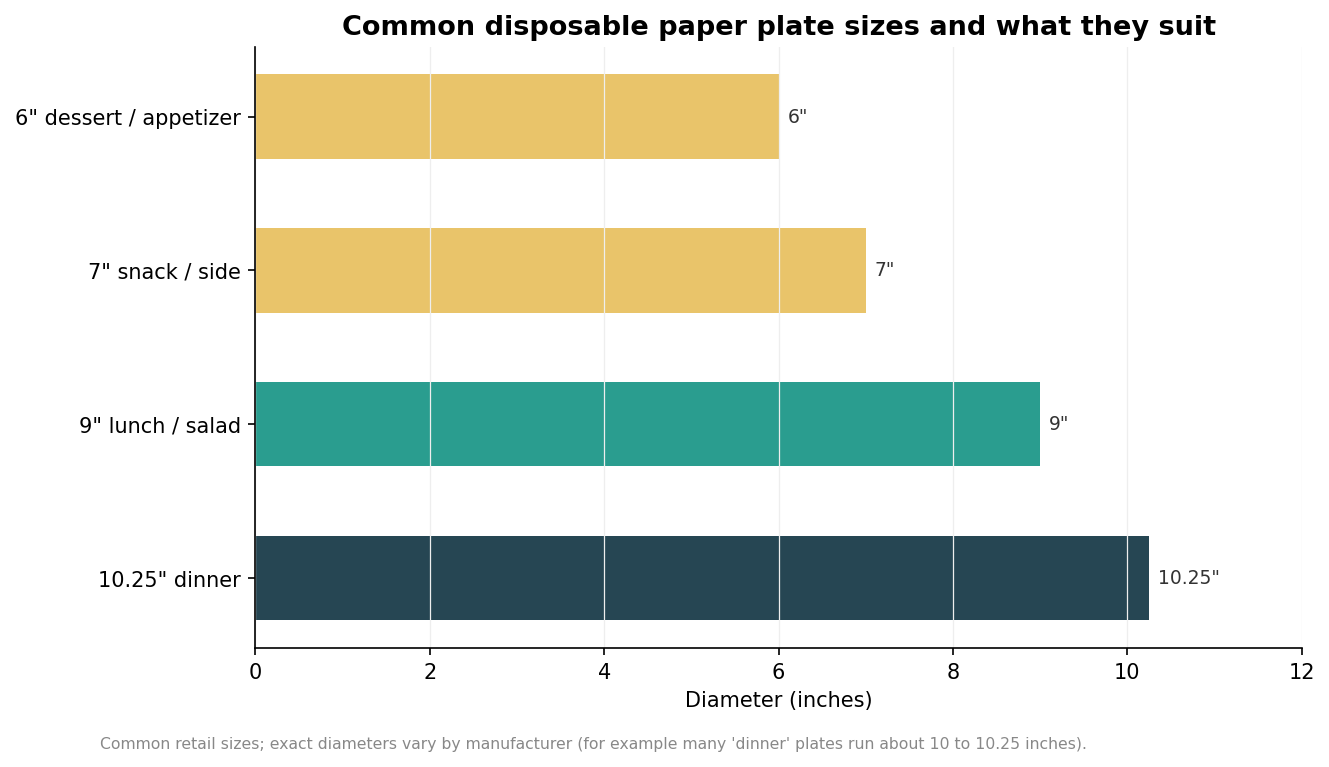
Sturdiness and size are easy to conflate, but they are chosen independently. Common disposable diameters run from about 6 inches for dessert and appetizers up to roughly 10.25 inches for dinner, with 7-inch snack and 9-inch lunch plates in between, though exact dimensions vary by maker. The chart below lays out the usual sizes and what each suits. Size interacts with weight in one important way: the larger the plate and the heavier the intended portion, the more GSM and rim reinforcement it needs to avoid flexing, because a big thin plate cantilevers food out toward an unsupported edge. A 10-inch dinner plate carrying a full meal is exactly where economy board fails.
Specifying custom-printed plates
When you add printing to the equation, a couple of extra factors come into play. Print quality depends on the surface, so a smooth, clay-coated or bright face reproduces logos and detailed artwork far better than a rough, uncoated board, and it is worth deciding print surface and barrier coating together rather than in isolation. Inks used on the food-contact or eating surface should be food-safe, so confirm that with your printer up front. Beyond materials, plan quantity realistically: a common rule of thumb is to budget one and a half to two plates per guest for an event, since people take fresh plates for seconds and dessert. Finally, order a printed sample before committing to a full run. A sample lets you confirm the color, check that the coating did not dull the artwork, and load the plate with the actual food it will serve, which is the only real test of whether the weight and build you specified are right.