The number printed on a case of paper plates does more work than most buyers give it credit for. A 9-inch plate and a 10.25-inch plate look almost identical stacked on a shelf, yet they behave very differently once food is on them and a line of guests is moving past a buffet. Picking the right diameter is the difference between plates that flex and drip and plates that carry a full meal without a second one underneath. This guide walks through how to match plate size to the way food is actually served, rather than guessing from the picture on the pack.
The standard sizes and what each one is really for
Disposable plates cluster around a handful of diameters, and each one maps to a serving role. The smallest, in the 5 to 6-inch range, are cocktail and appetizer plates: one or two hors d’oeuvres, a couple of tasting bites, a slice of cake held in one hand. Step up to 6.75 to 7 inches and you have the classic dessert and side-salad plate, big enough for a real portion but still easy to balance on a lap. The 8.5-inch luncheon plate is an in-between size that suits lighter mains, brunch, and kids’ meals. The workhorse is the 9-inch plate, the default for buffet mains and casual dinners because it holds an entree plus a couple of sides without wasting board. When presentation matters, the 10.25 to 10.5-inch plate gives a plated-dinner feel with room around the food, and 12-inch rounds and ovals move into platter and family-style territory.
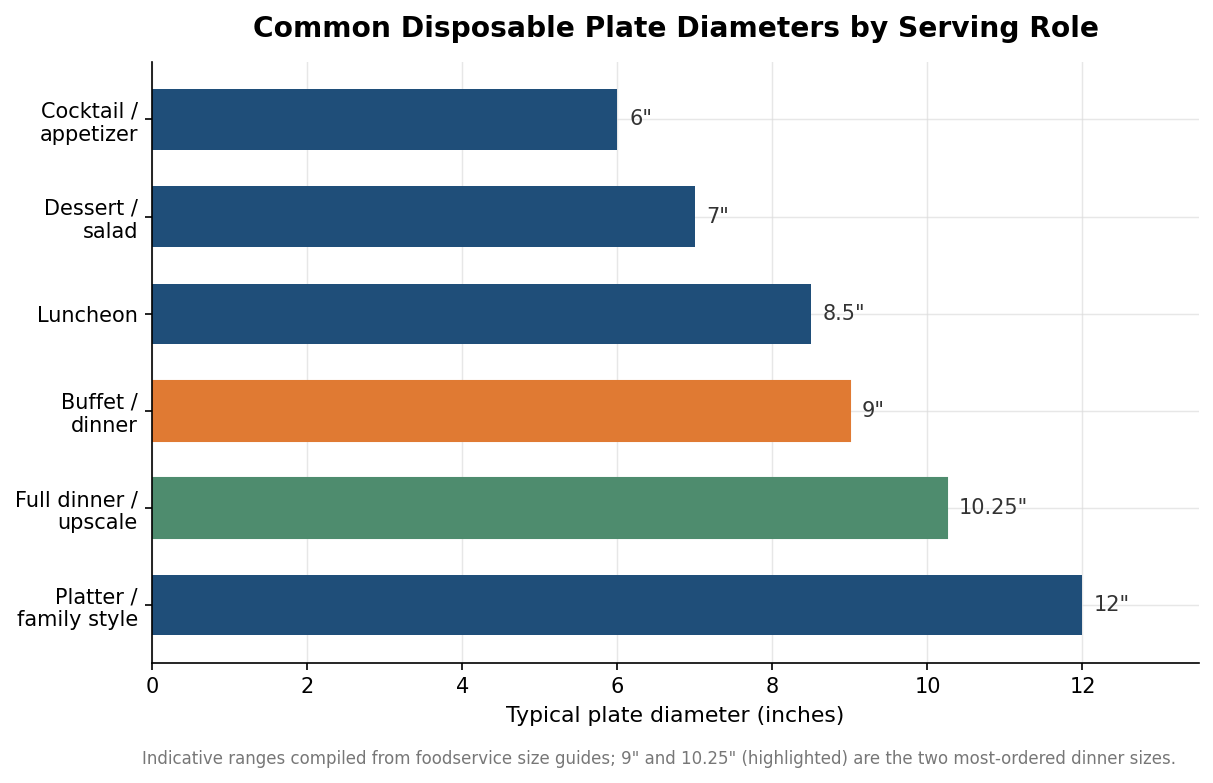
Those figures are indicative ranges rather than fixed standards; different converters trim a plate slightly differently, so a plate sold as 9 inches may measure 8.9 or 9.1 once you put a ruler across it. The categories, though, are consistent across the industry, and ordering by role rather than by a specific decimal keeps you from over-thinking it.
Match the plate to the format, not just the headcount
The most common sizing mistake is choosing a plate for the number of guests and ignoring how they will eat. A seated, plated dinner and a walk-around cocktail hour can have the same guest count and need completely different plates. For a seated meal where an entree and sides land together, a 9-inch plate is the floor and a 10.25-inch plate is more comfortable, especially if anything is saucy or the menu includes a starch, a protein, and a vegetable. For a buffet, err a little larger than you think, because guests build their own plates and tend to overfill; a 10.25-inch plate reduces the number of people who come back for a second plate on the first pass. For a cocktail or dessert reception, a 6 or 7-inch plate is right, and going larger just encourages people to pile on and generates more waste.
Portion planning gives a useful cross-check. A common catering rule of thumb budgets roughly 6 to 8 ounces of protein per guest on a main plate alongside two sides, which is exactly what a 9 to 10.25-inch plate is built to carry. For a two-hour cocktail window, planners often estimate somewhere around 8 to 12 appetizer pieces per guest across the whole event, which spreads comfortably over small 6-inch plates rather than a single large one. Treat those as starting estimates and adjust for your crowd and menu; they are planning heuristics, not guarantees.
Why a 10.25-inch plate holds far more than a 9-inch
Plate capacity does not grow in a straight line with diameter, and this trips up a lot of first-time buyers. Because a plate’s surface area is a function of the radius squared, a small bump in diameter buys a surprisingly large jump in usable space. A 9-inch plate has a face of roughly 64 square inches; a 10.25-inch plate has about 82 square inches, close to 30 percent more room, even though it is only an inch and a quarter wider. That extra area is why upgrading from 9 to 10.25 inches so often eliminates the “food touching the rim” problem at buffets.
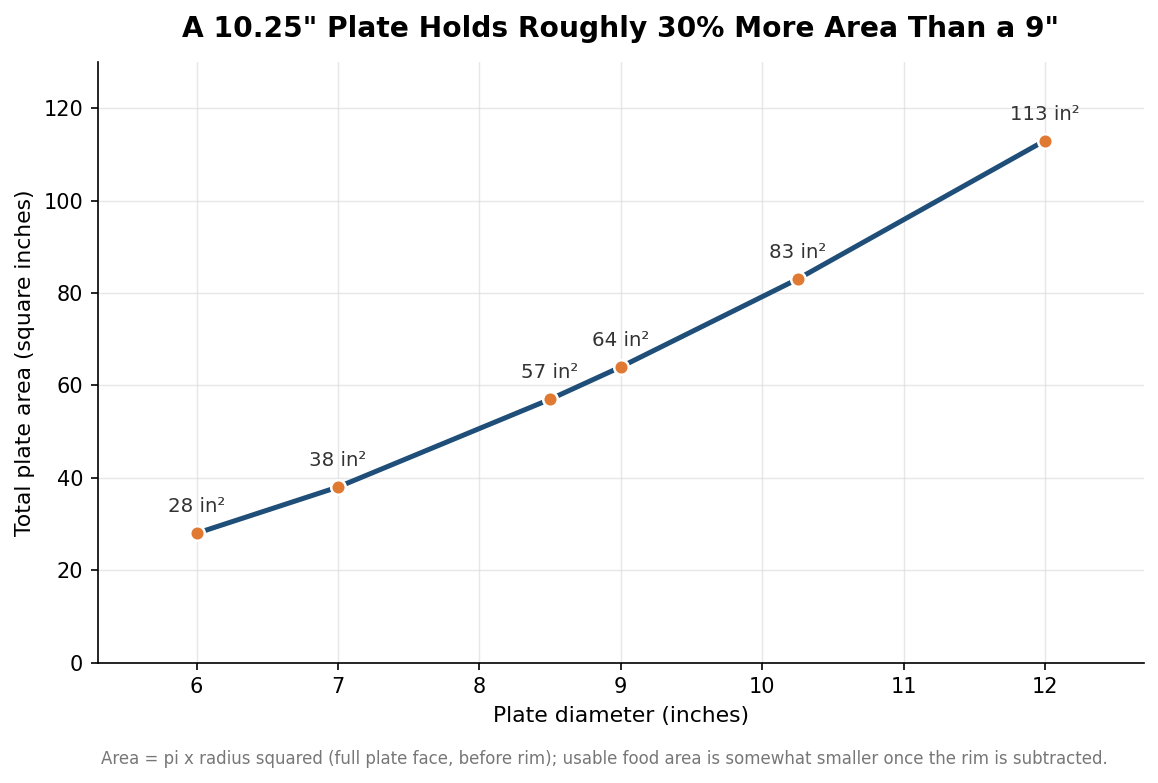
The same math runs the other way at the small end. A 6-inch plate has only about 28 square inches of face, less than half a 9-inch plate, which is exactly why it works for a single canape and fails the moment someone tries to use it for a full meal. When you are deciding between two sizes, think about the square-inch jump rather than the inch of diameter, because the area is what actually holds the food. The numbers above describe the full plate face; subtract a little for the rim to estimate the flat area food really sits on.
Compartment and oval plates: when a round plate is not enough
Round is not the only option, and the alternatives solve specific problems. Compartment plates, usually offered in 9 and 10.25-inch three-section formats, keep a saucy main from bleeding into a dry side and are a favorite for barbecue, picnics, and school or camp service where messiness matters. Oval platters in the 10 to 12-inch range give length for foods that do not fit a circle well, such as a sandwich with a side or a fish fillet. If your menu has wet and dry elements that should stay separate, a compartment plate often does more for the guest experience than simply sizing up a round plate, and it can reduce the double-plating that inflates your order quantity.
How size interacts with quantity, print, and cost
Size drives your order in two ways. First, larger plates cost more per piece because they use more board, so oversizing a 500-guest event adds up quickly; the goal is the smallest plate that comfortably holds the food, not the biggest plate available. Second, plates rarely map one-to-one to guests. For buffets and casual events, ordering somewhere around 1.5 to 2 plates per guest is a common allowance because people take fresh plates on return trips and a few get dropped or stacked unused; a single seated course is closer to one per guest. These are planning ranges to adjust to your event, not fixed rules.
Print changes the calculation slightly. A larger plate gives a custom design more room to read, which is why 9 and 10.25-inch plates are the most popular canvases for branded and event tableware, while a 6-inch plate limits you to a compact logo or monogram. If a printed rim or center graphic is central to the look, that can be a reason to choose the larger of two workable sizes. Whatever you land on, decide the serving format first, size the plate to the food, and let the guest count set the quantity, in that order, and the rest of the decision tends to fall into place.